Information for


Faculty & Staff
A Legacy of Encouragement
October 07, 2026



By Russell L. Keck, Ph.D., Associate Professor of English
Christopher Nolan’s Odyssey has been released to wide acclaim and not a little controversy. Though recognizing the spectacular cinematography and astounding practical effects, reviewers have mostly focused on Nolan’s creative choices as they pertain to the fidelity of his adaptation to the original 8th-century epic traditionally ascribed to the blind poet Homer. They point to his trimming of the narrative, his exclusion of the Greek gods and goddesses, his conflating of characters and locales, and most especially, his modernization of Odysseus’s morality and psychology. It becomes evident early in the film that Nolan has imbued his Odysseus with a profound sense of guilt and shame, troubled by the cost of war and traumatized by his own betrayal of the “Law of Zeus,” xenia in ancient Greek, which refers to the sacrosanct host-guest relationship meant to protect strangers and travelers.
Some, such as Emily Wilson, whose popular translation of The Odyssey served as the impetus for Nolan’s script (particularly the notion of Odysseus as the “complicated” man), excoriated Nolan for his emotionless and taciturn rendering of Odysseus in a viral article from the London Review of Books earlier this month. Others, like Luis Parrales from The Atlantic, have suggested that Nolan’s characterization of Odysseus “seems more biblical than Homeric,” drawing more from heroes in the Bible than those in Homer’s epic. However, a significant feature to Nolan’s Odysseus, which stays true to Homer’s text, and which has received too little attention, is the virtue of endurance.
While the metis (the Greek term for deceptive and cunning intelligence) of Odysseus gets all the glory, as it were, Odysseus’s resolute display of endurance speaks to the true strength of his character and rallies in us, the audience, the quiet heroism to meet the needs of each day.
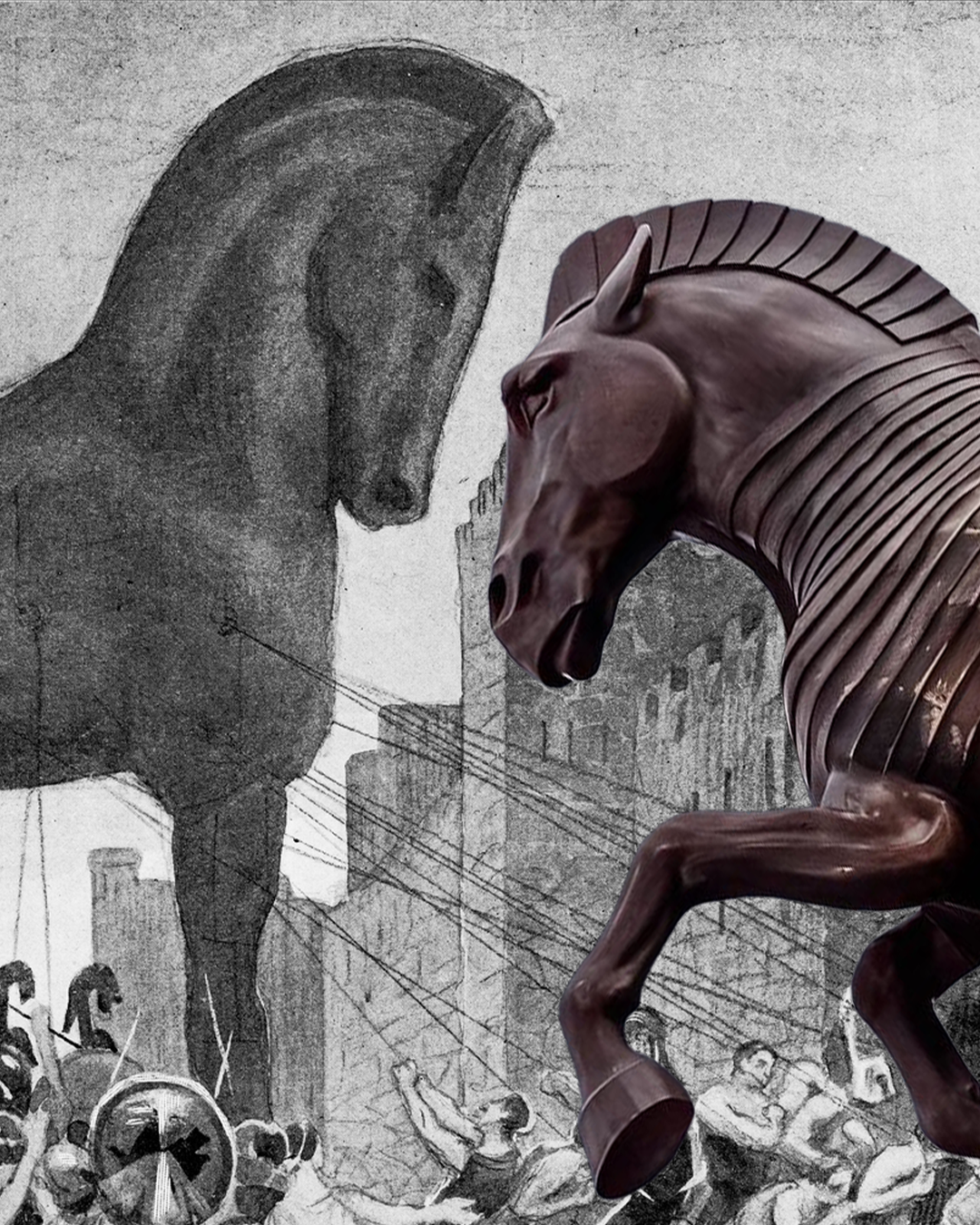
Odysseus spends 20 years away from home first fighting in a war and then struggling to return. Nolan’s film conveys well the malaise Odysseus and his Ithacans face during the 10-year Trojan War. They are desperate to expedite the war’s end by means of a daring gambit devised by Odysseus himself: the Trojan Horse. The silent fortitude of the Greek warriors hiding inside its claustrophobic wooden bowels evokes rather viscerally what it means to endure, to hold out in a state of agony for a long-awaited outcome. What’s more, the film excels at communicating the travails of the long journey home. For another three years Odysseus and his crew undertake one adventure after another, each with deadly trials and immense suffering, until only Odysseus is left. Nolan was right, I think, to lean into the horrifying elements of these adventures. The etymology of odyssey — more than simply the story of Odysseus — has its roots in the Greek words for suffering and grief. When Odysseus washes ashore the island of Ogygia and is cared for by the sea nymph Calypso, he is a physically and spiritually broken man, only able to crave the narcotic release of slothfulness and forgetfulness in the sweet petals of the lotus flower — an interesting emendation by Nolan as it is an earlier episode in Homer’s text (and famously depicted in the Alfred, Lord Tennyson’s “The Lotos-Eaters”). Should we be surprised that Odysseus, after experiencing the pangs of such wretchedness and desolation, would succumb to the temptation of apathy and amnesia? And yet, after seven years in this sedative state, his spirit of endurance rises like the rosy fingers of the dawn, to borrow language from Homer, and recalls his true purpose: to return to his home and reunite with his family. The homecoming is, as you might expect from an ancient epic, a bloody affair, and a final demonstration of heroic endurance. Nolan heightens this feat through the numerous wounds Odysseus receives at the hands of the suitors — in Homer’s poem, he remains unscathed. Both versions offer a familial triumph for the virtue of endurance exhibited not only in Odysseus but in Penelope and Telemachus as well. Without a dogged willingness to press on during hard times, and find hope beyond hope, their glad reunion and the restoration of order in Ithaca would not have been possible.
Daniel Mendelsohn’s recent translation of The Odyssey emphasizes this virtue more than any other I have read, accentuating Odysseus’s polytlas, “much-enduring” or “much-suffering,” as the necessary complement to his metis or craftiness. The value of Nolan’s film is that it captures the full essence of enduring long in life, what it means for Odysseus — and for each of us — to trudge on, to weather the storm, to get back on the horse.
The virtue of endurance is not usually so exciting. Nolan and Matt Damon portray that fact in the film; it doesn’t have the bravado of courage, the gravitas of piety, or the warmth of generosity. Nonetheless, it is a virtue to be cultivated in all of us. We might use synonyms like resilience or perseverance, which certainly share semantics, but I like endurance for its innate longevity and sense of hardheadedness (derived from the Latin durus or hard). Several reviews, of course, have teased that the audience requires long-endurance to make it through the nearly three-hour runtime of Nolan’s film. Yet, in those few ticks of the clock, Nolan reminds us that part of humanity’s answer to despair, hopelessness, cynicism and apathy is to endure. What follows endurance is homecoming and reunion. Perhaps, this is why the writer of Hebrews employs the same language to those who would live by faith: “let us run with endurance the race that is set before us, looking to Jesus, the founder and perfecter of our faith, who for the joy that was set before him endured the cross, despising shame, and is seated at the right hand of the throne of God” (Hebrews 12:1-2 ESV).