Information for



Department
KVHU 20th Anniversary
October 23, 2026



By Laura Miller, Student Writer
When eighth-grade science teacher Brett Baker wanted to help his students better understand gravity, he decided to take his lesson outside the classroom, and all the way up to the sky – thousands of feet above the ground.
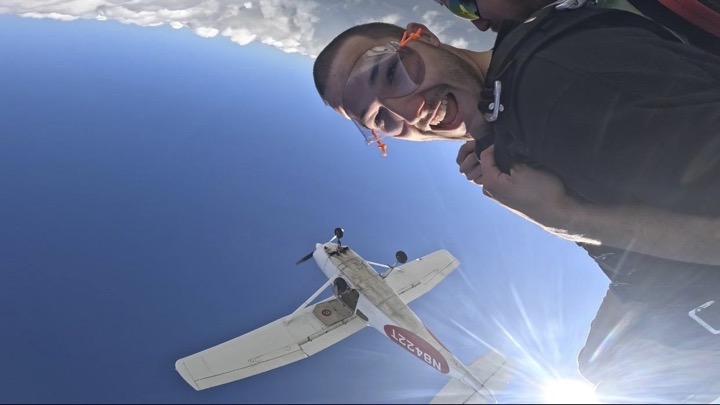
Baker, a second year teacher at Ahlf Junior High School in Searcy, and a Cannon-Clary College of Education graduate student, went skydiving to demonstrate gravity in action, and recorded his experience to show his students how force affects falling objects.
His idea developed over the summer as Baker and his fellow science teachers were brainstorming ways they can better improve their lessons on Earth’s forces. While the team had already developed new hands-on experiences, Baker wanted to take his lesson on gravity to the next level.
“Then it hit me,” Baker said. “Falling from the sky is a good example of gravity.”
After receiving encouragement from his wife and fellow colleagues, Baker booked the skydiving appointment and began preparing to turn the experience into a classroom lesson.
He completed his free fall during the second week of school, but wanted to keep his experience a secret until the fifth week, when they began studying gravity and air resistance.
Baker introduced the video during one of his lessons, leaving out the detail that he was the person skydiving. However, as the video panned to him walking, his students began to freak out, realizing that it was their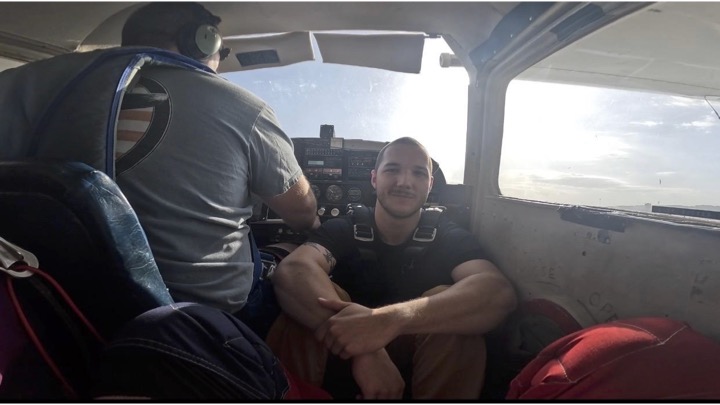 teacher.
“When I jumped out of the airplane, all of my classes were full of a variety of reactions,” Baker said. “Some scared, some excited and some questioning my sanity.”
As the video played, he explained the concepts of altitude, gravity and air resistance, connecting the footage back to his original lesson.
“One of the most memorable responses I got was from a student who said, ‘Mr. Baker, it was pretty cool how you risked your life to teach us,’” Baker said.
However, for him, the students’ excitement and questions demonstrated the importance of creating opportunities for curiosity in the classroom.
“I’ve always thought of curiosity as a teachable skill that can be grown and strengthened over time,” Baker said.
Encouraging students to ask questions and discover answers independently is central to Baker’s teaching philosophy, especially as information has become increasingly available online.
“Change only happens when someone is curious and asks why,” Baker said.
Beyond skydiving, Baker has incorporated demonstrations such as skateboarding across desks to explain Newton’s laws and launching soda rockets while talking about Newton’s third law, all to keep his students engaged and curious about science.
Although the skydiving demonstration attracted attention for its unconventional approach, Baker said his ultimate goal extends beyond teaching his students about gravity, but it’s reflected in a message he shares with his students at the beginning of each school year.
“At the start of each school year, I tell every class, ‘when you leave this class, I want you to leave believing that science isn’t boring and learning is fun,’” Baker said.